



How High to Hang Wall Art: The "Golden Rule" for a Perfect Home
Have you ever finished hanging a beautiful piece of art, stepped back, and realized it just looks... off? You’re not alone. The most common mistake people make in interior design isn’t the art they choose—it’s hanging it way too high.
There’s a simple, foolproof answer. And you don’t need a degree in interior design to get it right. Let me show you exactly how high to hang wall art in every room of your house.
The Golden Rule: 57 Inches on Center
In the world of professional galleries and museums, there is a standard height for hanging art: 57 inches (145 cm) from the floor to the center of the piece.
Why 57 inches? This is the average human eye level. By keeping the center of every frame at this height, you create a consistent visual line throughout your home, making the space feel balanced and intentional.
Here’s how to apply it:
- Measure the height of your artwork
- Divide that number by 2 (this finds the vertical center)
- Add that number to 57
Example: Your art is 20 inches tall. 20 ÷ 2 = 10 inches. 57 + 10 = 67 inches from the floor to the top of the frame (or 57 inches to the center).
Most people find it easier to measure to the center. Just mark 57 inches on your wall, and align the middle of your art with that mark.

What If You’re Hanging Art Above Furniture?
The 57-inch rule is your starting point. But furniture changes things.If you’re hanging art above a sofa, bed, or console table, you need to connect the art to the furniture — not to the ceiling.
The rule for furniture: Hang art 6 to 12 inches above the back of the furniture.
| Furniture Type | Recommended Gap |
|---|---|
| Sofa | 8–10 inches |
| Bed (headboard) | 6–8 inches |
| Console table | 6–12 inches |
| Desk | 6–10 inches |
The goal is visual connection. If you hang art too high above a sofa, it feels like it’s floating away. If you hang it too low, it crowds the people sitting there.
Pro tip: The art should be about two-thirds to three-quarters the width of the furniture underneath it. A tiny painting above a massive sofa looks lost. A giant canvas above a small bench looks overwhelming.

Room-by-Room Guide: How High to Hang Wall Art
Different rooms have different needs. Let me walk you through each one.
Living Room:
This is where most people struggle. You have high ceilings, a large sofa, and maybe some side chairs.
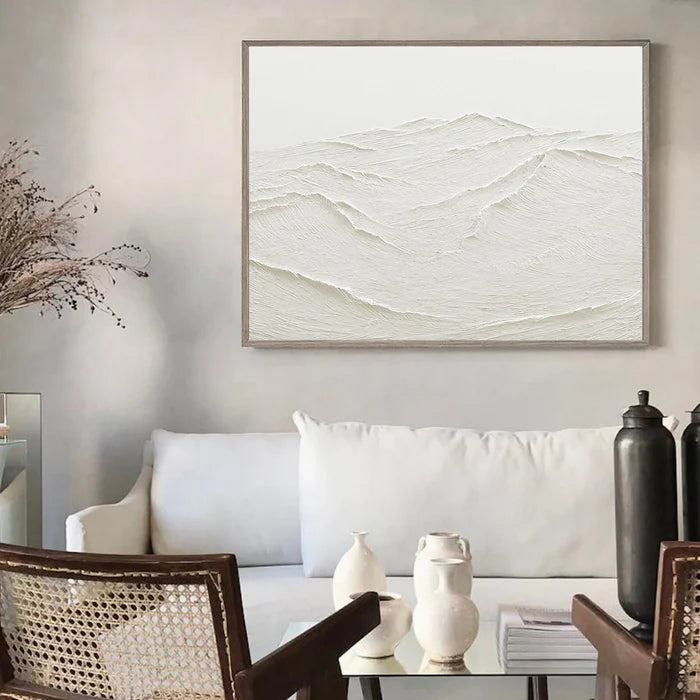
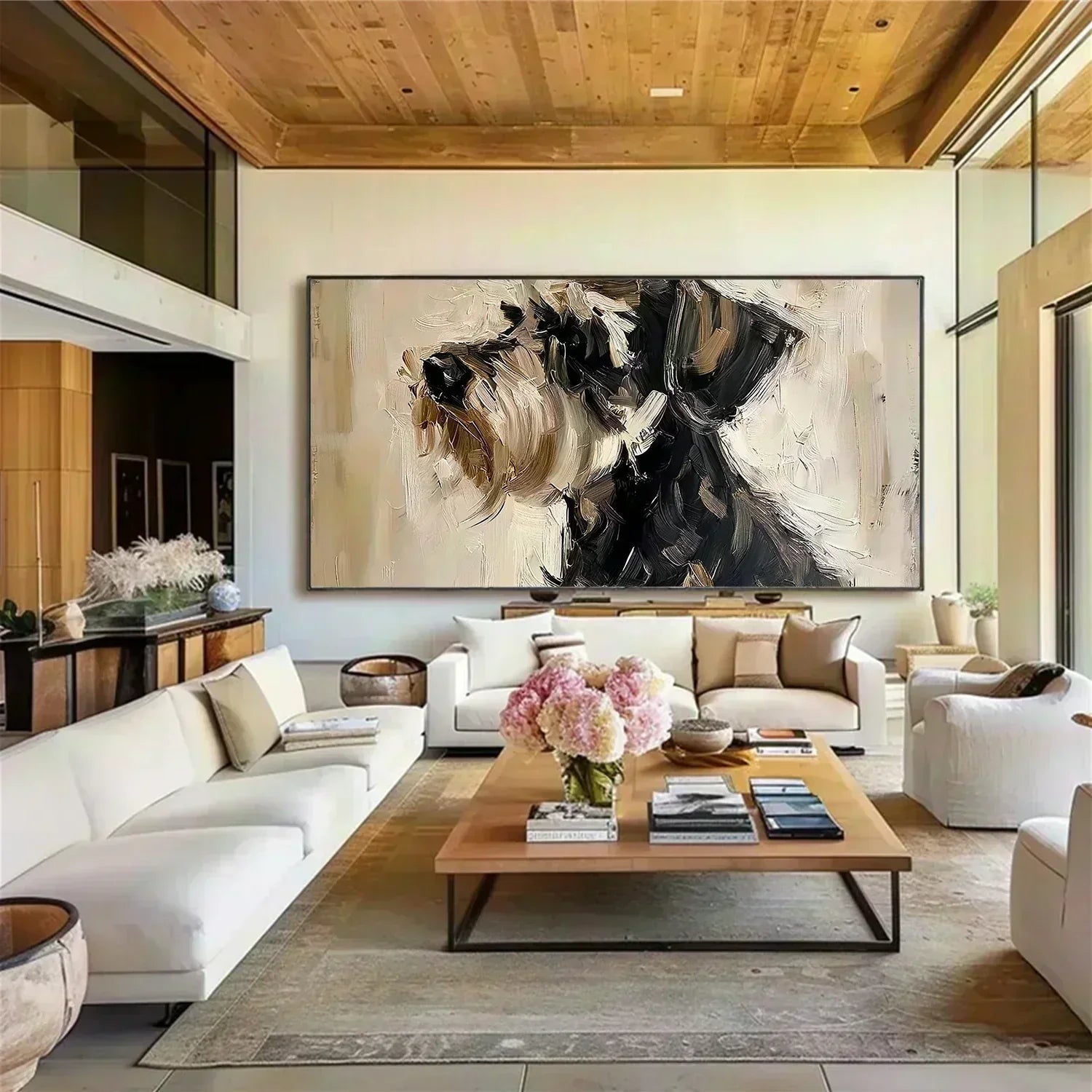
- Above the sofa:8–10 inches above the back of the sofa. Center of art at roughly 57–60 inches from the floor.
-
On empty walls:Stick with 57 inches on center.Don't be tempted to hang art higher just because you have tall ceilings.Your eye level didn't change.
Bedroom:
Bedroom art should feel calm and personal.
- Above the headboard:6-8 inches above the headboard.You want the art to feel connected to the bed, not floating towards the ceiling.
- On side walls:57 inches on center works perfectly here too.
- Once common mistake:Hanging art too high above a tall headboard.The headboard already takes up vertical space.Keep the gap tight(6-8 inches max).
Dining Room:
Dining rooms often have buffet tables, sideboards, or empty walls.
-
Above a buffet or sideboard:6-12 inches above the furniture.And remember the width rule-the art should be narrower than furniture below it.
-
a standalone wall: Back to 57 inches. Dining rooms feel more formal when art is hung at proper eye level.
Hallway:
Hallways are tricky because people walk close to the wall and often view art from an angle.
- Standard hallway: 60 inches to the center (slightly higher than 57 inches). This accounts for the fact that most people glance at hallway art while walking, not standing and staring.
- Narrow hallway: Go with 57 inches. Lower is better in tight spaces because it keeps the art within comfortable viewing range.
Kitchen:
Kitchen art is usually smaller and placed above open shelves, window frames, or along a backsplash.
- Above open shelving: 4–6 inches above the shelf. Kitchen art doesn't need to follow the 57-inch rule as strictly — function matters more here.
- On an empty wall: 57 inches works, but lower can be fine if the art is small and you're often seated at a breakfast bar.
Bathroom:
Bathrooms have mirrors, vanities, and sometimes small pieces of art.
- Above open shelving: 4–6 inches above the shelf. Kitchen art doesn't need to follow the 57-inch rule as strictly — function matters more here.
- On an empty wall:57 inches works, but lower can be fine if the art is small and you're often seated at a breakfast bar.
Stairways:
Hang art every few steps so that it "climbs" with you. A good trick is to measure 57 inches up from every third step and let that guide your center point.
💡 Design Tip: Looking for a statement piece that truly captures the room? The abstract and textured collections from eleanosgallery feature high-contrast palettes designed to pop when hung at the standard gallery height.

How High to Hang Wall Art on Gallery Walls
Gallery walls follow a similar principle, but with one key difference:Treat the entire gallery as one unit.
- Find the Center: Determine the center point of the entire grouping and place that point at the 57-inch mark.
- Spacing: Keep the distance between frames tight—usually 2 to 3 inches. If the gap is too wide, the collection will look cluttered rather than cohesive.
Pro tip:Lay out your design on the floor first or use paper templates on the wall before committing.

Related Reading:How to Arrange Wall Art in Every Room: A Designer’s Guide to Pro-Level Hanging
3 Common Mistakes to Avoid When Hanging Wall Art
Hanging Too High
Don't be tempted to hang art higher just because you have high ceilings. People live at eye level, not ceiling level. Keep the art grounded.
Ignoring the Ceiling Height
If you have very high ceilings (10 feet or more), you can nudge the 57-inch rule up slightly, but don't overdo it. The art should still relate to the people in the room, not the ceiling.
The "Lonesome" Piece
Don't put a small 8x10 photo on a massive wall by itself. If the wall is big, the art needs to be big—or grouped with other pieces.
Q&A
Q1: What if my husband is 6'4" and I'm 5'2"? Whose eye level do we use?
A: Stick to the 57-60 inch gallery standard. It’s not about your specific height, but about the "optical center" of the room. Consistency is what makes a home feel professionally designed.
Q2: Should art be centered on the wall or centered over the furniture?
A: Always center the art over the furniture. If your sofa is off-center on a long wall, centering the art on the wall will make the whole room look lopsided.
Q3: Is it okay to lean art against the wall instead of hanging it?
A: Yes! Leaning art on a mantle, a dresser, or even the floor (for very large pieces) is a popular "cool-girl" design move. It feels casual and allows you to swap pieces without making holes in the drywall.
Q4: How do I avoid making multiple "oops" holes in my wall?
A: Trace your frames onto Kraft paper, cut them out, and tape them to the wall with painter's tape first. Move the paper around until it looks perfect, then hammer the nail right through the paper.
Summary
Hanging wall art doesn't have to be a guessing game. Stick to the 57-inch center rule for open walls and a 6-10 inch gap above furniture. Your home will immediately feel more curated, balanced, and professional.
Read more
How to Hang Wall Art Without Nails? 8 Damage-Free Decorating Methods
Hanging wall art without nails is not only possible—it’s actually the preferred method for many DIYers today. Here is a guide to the best damage-free methods to turn your blank walls into a gallery...
Read more
How To Choose The Right Art For Your Space: A Complete Design Guide
Transforming a house into a home often comes down to the final layer of design: the art on your walls. While furniture provides function, wall art provides the soul. However, staring at a blank whi...
Read more