


If you've ever seen two separate canvas panels hanging side by side that together create one complete artwork, you've already encountered a diptych painting.
Diptych paintings have been used by artists for centuries, from religious masterpieces in medieval churches to modern abstract wall art found in contemporary homes. Today, diptych artwork remains one of the most popular formats in interior design because it adds visual interest, balance, and a sense of movement to a space.
In this guide, you'll learn what a diptych painting is, where it originated, the different styles available, and how to decorate with one in your home.
What Is a Diptych Painting?
The word diptych (pronounced 'dip-tik) comes from the ancient Greek words "di", meaning two, and "ptyche", meaning fold.
In the art world, a diptych is any artwork made up of two distinct panels or sections that are meant to be viewed together as a single piece.
Historically, these two panels were physically joined by hinges, allowing the artwork to open and close like a book. In modern times, artists often create diptychs on two separate canvas frames that simply hang right next to each other on a wall.

The History of Diptychs
Diptychs weren't always meant for canvas paintings. They actually started as a tech tool in ancient Rome and Greece!
1. Ancient Notebooks
Originally, a diptych was a two-leaf wooden or ivory tablet filled with wax. People used a stylus to scratch notes into the wax, then folded it shut to protect the text.
2. The Middle Ages & Renaissance
As Christianity grew, religious artists adopted the format. They painted sacred scenes on small, hinged wooden panels. Travelers could easily fold these up, pack them in a bag, and use them for private prayer on the road.
3. Modern Day
Today, diptychs have moved past purely religious art. Modern and contemporary artists use the two-panel format to tell stories, show contrast, and create a powerful visual impact in homes and galleries alike.
Why Do Artists Create Diptych Paintings?
Creating one cohesive painting is hard enough, so why split an artwork across two panels? Artists use diptychs for several clever reasons:
1. To Show Contrast and Balance
A diptych allows an artist to place two opposing ideas side-by-side. For example, one side might represent life while the other represents death, or one panel could feature warm colors while the other uses cool tones.
2. To Tell a "Before and After" Story
Because we naturally read from left to right, a diptych is perfect for showing a sequence of events or a transformation over time.
3. Practicality for Large Spaces
For modern interior designers and artists, shipping and hanging one massive canvas can be a nightmare. Splitting a panoramic landscape across two separate canvases makes it much easier to transport, frame, and hang, while still filling up a large wall beautifully.
Common Types of Diptych Paintings
While all diptychs consist of two panels, artists use this format in different ways to create unique visual effects.
1. Continuous Image Diptychs
A continuous image diptych divides one large composition across two canvases. When displayed together, the image flows seamlessly from one panel to the other. This style is commonly used for landscapes, city skylines, ocean views, and panoramic scenes.
2. Abstract Diptychs
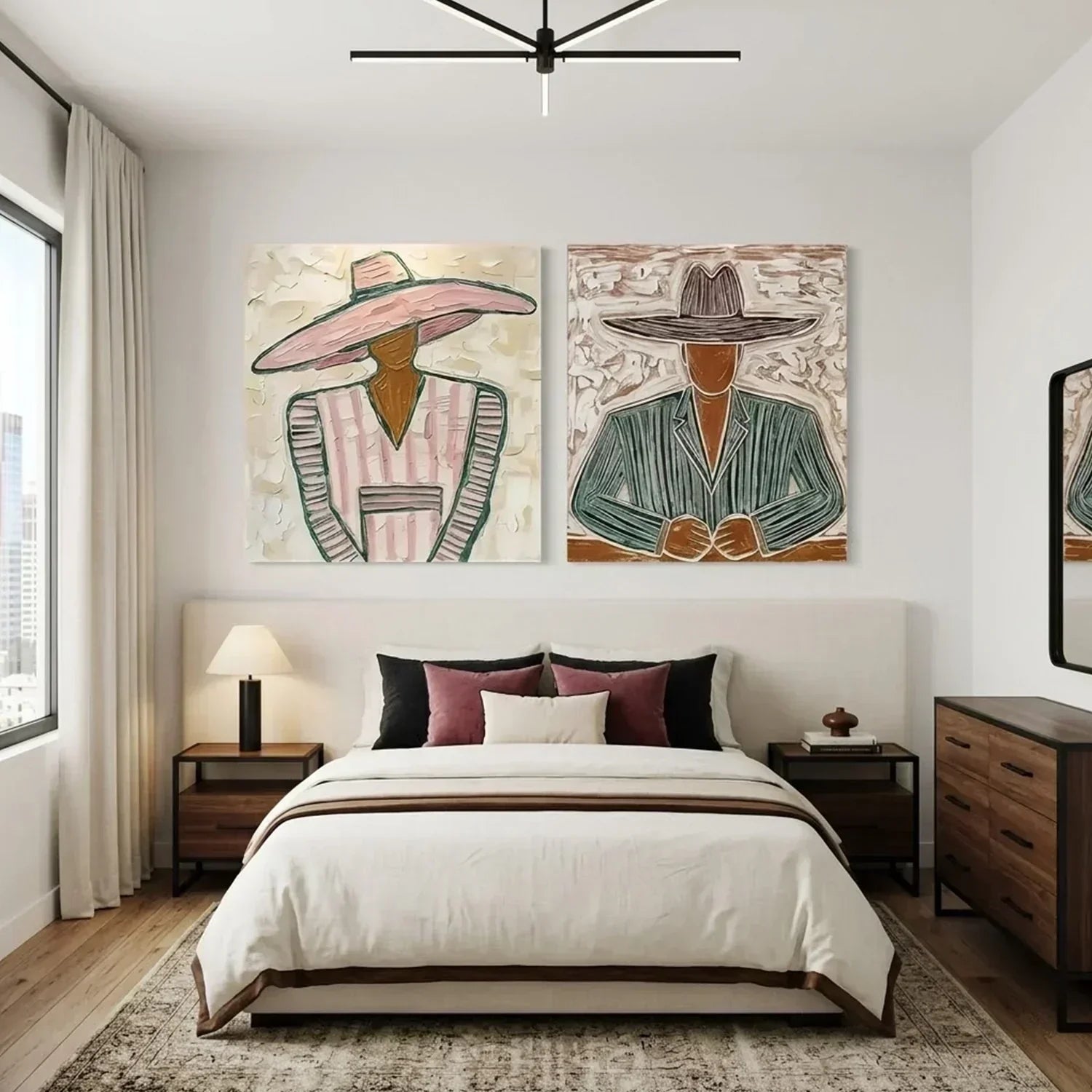
Abstract diptychs use similar colors, textures, and shapes to create a cohesive look without forming one continuous image. They are especially popular in modern interiors because they add balance, depth, and visual interest.
3. Contrast Diptychs
Contrast diptychs place opposing elements side by side, such as light and dark, nature and urban life, or past and present. The visual tension between the two panels becomes a key part of the artwork’s meaning.
4. Narrative Diptychs
Narrative diptychs tell a story in two parts. One panel may show a beginning, while the other reveals a result, transformation, or later moment. This format helps artists express movement, change, and the passage of time.
Examples of Diptych Paintings
Below are some common examples of diptych artwork styles.
1. Abstract Textured Diptych
Two canvases share the same color palette and texture while featuring slightly different compositions. Together, they create balance and movement without relying on a single continuous image.

Best for: Modern living rooms, offices, and minimalist interiors.
2. Landscape Diptych
A panoramic landscape is split across two panels. When displayed side by side, the image feels larger and more immersive than a traditional single canvas.

Best for: Living rooms, hallways, and large feature walls.
3. Floral Diptych
Flowers or botanical elements are arranged across two separate canvases. The design creates elegance and symmetry while adding softness to a room.

Best for: Bedrooms, dining rooms, and feminine interior styles.
4. Black-and-White Contrast Diptych
The two panels intentionally oppose each other through color, shape, or subject matter. This style emphasizes duality and visual drama.

Best for: Contemporary and industrial interiors.
How to Hang a Diptych Painting
Proper placement can make a significant difference in how a diptych is perceived. Since the artwork is divided into two panels, the spacing and alignment should feel intentional and balanced.
1. Keep Consistent Spacing
Most designers recommend leaving 2–6 inches (5–15 cm) between the panels, depending on their size. The gap should be wide enough to distinguish the two canvases while still maintaining a clear visual connection.
2. Align Heights Carefully
For a cohesive look, both panels should be hung at the same height. Even small alignment differences can disrupt the overall composition and make the artwork feel uneven.
3. Treat It as One Artwork
Rather than centering each canvas separately, center the entire diptych as a single piece. This helps create a more balanced and professional appearance.
4. Match the Wall Size
Choose a diptych that suits the scale of your wall and furniture. Larger diptychs work particularly well above beds, sofas, and dining tables, where they can serve as a striking focal point.
Diptych vs. Triptych: What's the Difference?
| Feature | Diptych | Triptych |
|---|---|---|
| Number of Panels | 2 | 3 |
| Visual Style | Balanced and simple | More dramatic and expansive |
| Space Requirement | Moderate | Larger walls |
| Popular Use | Homes and offices | Galleries and statement spaces |
A diptych uses two panels, while a triptych extends the concept to three connected panels.
FAQ
What does diptych mean in art?
A diptych is an artwork consisting of two connected panels that are intended to be displayed together as a single composition.
Can two separate paintings be called a diptych?
Only if the artist designed them to function together conceptually or visually. Otherwise, they are simply a pair of matching artworks.
How far apart should diptych panels be hung?
Most designers recommend a gap of 2–6 inches, though larger artworks may require slightly wider spacing.
Are diptych paintings modern?
Not exclusively. Diptychs date back centuries, but they remain highly popular in contemporary interior design.
Where should I hang a diptych painting?
Common locations include above beds, sofas, fireplaces, dining tables, and entryway consoles.
Conclusion
A diptych painting is more than just two canvases placed side by side. It is a carefully designed artwork that uses two panels to create a unified visual experience. From ancient religious icons to contemporary abstract wall art, diptychs have remained relevant because they combine artistic storytelling with striking visual balance.
For homeowners and art lovers alike, a well-chosen diptych can transform an empty wall into a sophisticated focal point while adding depth, movement, and character to a space.
To find a diptych that enhances your home with both style and quality, consider handcrafted collections like Eleanos Gallery, which offers modern abstract and large textured pieces. Whether placed above a sofa or a dining table, a well-chosen diptych adds balance and creates a sophisticated focal point in any contemporary space.




Leave a comment
This site is protected by hCaptcha and the hCaptcha Privacy Policy and Terms of Service apply.