



How Big Should Wall Art Be Above a Sofa for the Perfect Look?
Choosing the right wall art size above a sofa is one of those home décor decisions that looks simple until you actually try it. Most people either end up with art that feels too small and “floating,” or something so large it overwhelms the entire living room.
While traditional interior design rules help, real-world discussions from home décor communities show something interesting: people don’t struggle with the rules—they struggle with visual perception after installation. In other words, the issue is not math, it’s how scale feels in real space.
This guide breaks down both the standard sizing logic and the more practical, experience-based insights that often don’t show up in design blogs.
What Is the Standard Rule for Wall Art Above a Sofa?
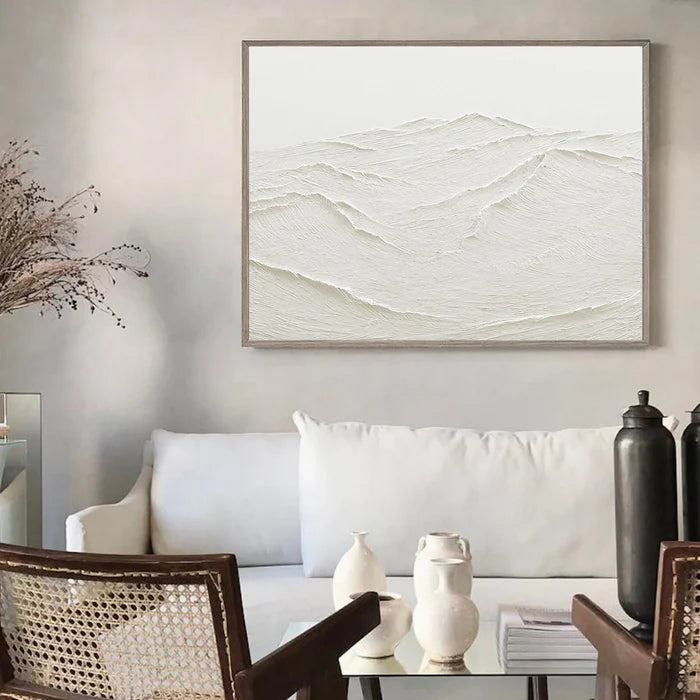
One of the most widely accepted interior design principles for hanging wall art above a sofa is the Two-Thirds Rule. In simple terms, the artwork should generally span about 60% to 75% of the width of the sofa beneath it. So, if your sofa is around 90 inches wide, the ideal artwork size would typically fall somewhere between 54 and 67 inches wide.
This guideline works because it creates visual balance between the furniture and the wall décor. When the artwork is proportionally connected to the sofa, the entire arrangement.

The Hidden Problem:Why the "Two-Thirds Rule" Sometimes Feels Wrong
However, while this rule is technically correct, many people still feel their artwork looks too small after hanging it above the sofa. The reason is simple: most sizing advice only considers the sofa, not the entire wall around it.
Let me be clear: the two-thirds guideline isn't wrong. It's just incomplete.
In real living rooms, factors like high ceilings, wide empty walls, open layouts, and lighting can make artwork appear visually smaller than expected. So while the proportions may be technically correct, the piece can still feel underwhelming once it is actually installed.
One important thing many people overlook is this: wall art is not only balancing the sofa — it is balancing the entire wall. That is also why oversized art has become so popular in modern interiors. Larger pieces help fill visual space more naturally and create a stronger sense of balance in the room.

How Ceiling Height Affects Wall Art Size Above a Sofa
Here's something almost no design article mentions: the relationship between your art and your ceiling matters more than the relationship between your art and your sofa.
Think about it. Your sofa anchors the lower half of the wall. Your ceiling defines the upper limit. The art lives in between. If you only consider the sofa, you ignore half the equation.
Low ceiling (7 to 8 feet): Your room already feels compressed. Don't make it worse by hanging art that stretches too high. Keep your art relatively low—6 to 10 inches above the sofa—and choose pieces that are wider than they are tall. This pulls the eye horizontally, making the ceiling feel higher than it actually is.
Standard ceiling (8 to 9 feet): This is where the two-thirds rule actually works well. You have room to breathe. Art can be substantial without overwhelming the space.
High ceiling (9 to 12+ feet): Here's where most people make a mistake. They hang art at the same standard height, leaving a massive empty gap between the art and the ceiling. The result? The room looks unfinished, and the sofa looks tiny. Instead, hang your art higher—12 to 18 inches above the sofa—or choose a single very tall piece (or vertical arrangement) that climbs toward the ceiling. You want to activate that upper wall, not abandon it.
Real example: A friend of mine has a 10-foot ceiling and a 70-inch sofa. Standard advice would suggest art roughly 48 inches wide, hung 8 inches above the sofa. She tried it. The room felt awkward—all that empty space above the art just sat there, doing nothing. She replaced the single piece with three tall vertical panels, each 18 inches wide and 48 inches tall, hung 14 inches above the sofa. The panels reached almost to the ceiling. Suddenly, the room felt intentional. The height became a feature, not a bug.

Should Wall Art Be Bigger Than the Sofa?
Here's a counterintuitive idea: your art can be wider than your sofa.
Shocking, right? The internet told you two-thirds. But walk into any professionally designed home and you'll see sofas paired with art that extends significantly past the armrests.
Why this works? When art is wider than the sofa, it visually anchors the entire seating area. The sofa becomes a component within a larger composition, rather than the sole focus of the wall. This is especially effective in open floor plans where the sofa "floats" away from the wall. The oversized art creates a visual boundary, making the seating area feel distinct and grounded.
When to try this:
- Your sofa is on the smaller side (under 70 inches)
- Your room is large and needs help defining zones
- You're using a triptych (three pieces) that collectively span wider than the sofa
- You want the wall to feel like a gallery, not just furniture support

When to avoid this:
- Your sofa already dominates the room (oversized sectional, deep seating)
- The wall has doors, windows, or other interruptions
- Your ceiling is very low (the wide art will feel heavy and oppressive)

The One-Third, Two-Thirds Hack
Instead of obsessing over exact measurements, try this visual trick. Stand back and look at your wall. Mentally divide it into three vertical sections:
- Bottom section: The sofa itself (18 to 36 inches high, depending on your sofa back)
- Middle section: The space between the sofa and the art (6 to 12 inches typically)
- Upper section: The space between the art and the ceiling
Here's the secret: these three sections should feel intentional, not equal.
- Option A (Standard balance): Art is the largest section. The gap above the art is roughly the same size as the gap below the art. This is safe, predictable, and rarely wrong.
- Option B (Drama): Art fills most of the middle section and extends deep into the upper section. The gap above the art is very small. This works for tall ceilings and bold, oversized pieces.
- Option C (Deliberate emptiness): Art is relatively small, leaving generous empty space both above and below. This is risky but powerful—it creates a modern, almost Japanese sense of restraint. Works best with minimalist decor and negative space treated as an active design element.

The Sofa Shape Changes Everything
We talk about sofa width constantly. We almost never talk about sofa height or silhouette. That's a mistake.
Low-profile sofa (back height under 28 inches): Your sofa sits visually low. Art hung at standard height (6 to 8 inches above) will feel disconnected—like two separate things floating on the wall. Instead, close that gap. Hang art 4 to 6 inches above the sofa. The tighter connection makes the whole composition feel cohesive.
High-back sofa (back height over 34 inches): Your sofa already commands visual weight. It reaches upward. Art hung too high will compete with the sofa back. Hang art slightly higher than usual (10 to 12 inches above) to give each element its own breathing room. And choose art with some visual "lightness"—lighter frames, brighter colors, or more open composition—to avoid a wall that feels like a solid block of stuff.
Sectional with a chaise: Standard width measurements fall apart here because the sofa isn't rectangular. Instead of centering art over the "middle" of the sectional (which often looks random), center it over the main seating area—the part where people actually sit facing forward. Let the chaise extend past the art. That asymmetry looks intentional and modern.
The Eye Level Myth
Gallery rule #1,482: hang art at eye level. 60 to 66 inches from the floor to the center of the piece.
This works in museums. It works in hallways. It often fails above a sofa.
Why? Because your sofa isn't a blank wall. When you're sitting on the sofa, your eye level is lower (roughly 40 to 48 inches from the floor). When you're standing in the room, your eye level is higher. Hanging art at 60 inches might look perfect from standing height and feel weirdly high from sitting height.
A better approach: Stand back and look at the whole wall. Then sit on the sofa and look again. Find the height where the art feels comfortable from both positions. For most sofas, that lands between 54 and 66 inches from the floor to the center of the art—but the exact number depends on your sofa height, ceiling height, and personal preference.
There's no magic number. There's only how it feels to you in your space.
A Simple Step-by-Step Process
Forget rules. Try this instead:
- Measure your wall width. Not your sofa—your wall. If your sofa is 80 inches wide but the wall is 120 inches wide, your art should relate to the wall, not just the sofa. Centering a 60-inch piece above a sofa on a 120-inch wall leaves 30 inches of empty wall on each side. That might be fine. Or it might look lost.
- Tape it out. Use painter's tape to mark exactly where the art will go. Live with the tape outline for 24 hours. Walk past it. Sit on the sofa and look at it. Stand in the doorway and look at it. If it feels wrong, adjust the tape. This costs nothing and saves you from drilling holes you'll regret.
- Consider the whole room. Walk to the other side of the room. Does the art relate to anything else? A window, a bookshelf, a floor lamp? The best wall art doesn't just work with the sofa—it works with the entire room.
- Ignore every rule except one. Does it look good to you? Yes? Then it's right.
Why Oversized Art Solves More Problems Than It Creates
One interesting trend in modern interiors is the shift toward intentionally oversized wall art.
Why it works better than expected:
- It anchors large walls visually
- It reduces the “empty wall anxiety” effect
- It simplifies styling decisions
- It creates a focal point instantly
The biggest misconception is that oversized art is risky. In reality, undersized art is the more common design mistake.
In modern interiors, this design direction is often supported by curated oversized pieces such as those from Eleanos Gallery, which focuses on Wabi Sabi wall Art and abstract wall art designed specifically for large-scale wall presence. These types of artworks are intentionally created to work with spacious walls and help achieve a more cohesive, designer-level visual balance rather than feeling like simple decoration.

QFA
Q1: Is it better to go slightly bigger or smaller than the recommended size?
Most design discussions suggest going slightly bigger is safer. Small artwork is the most common regret because it makes the wall feel unfinished or “floating.”
Q2: Should wall art match the sofa size or the wall size?
It should primarily relate to the sofa, but visually it also needs to respond to the wall. Many people overlook that the wall creates the overall scale perception, not just the furniture.
Q3: Is one large artwork better than multiple small frames?
In modern interiors, many users prefer one large piece because it creates a stronger focal point and feels more cohesive. Multiple small frames often feel scattered unless carefully arranged.
Final Thoughts
Yes, the two-thirds rule is a useful starting point, but real-world experience reveals a more important insight: people rarely regret choosing artwork that is slightly too large, while they often regret selecting pieces that are too small. In most cases, undersized art fails to hold visual weight and leaves the wall feeling unfinished.
Because of this, successful living room designs today are less about strictly following formulas and more about achieving overall visual balance. Factors like wall presence, spatial proportion, and confidence in scale tend to matter more than precise measurements.
Read more

14 Best Places to Buy Affordable Large Wall Art: A Practical Guide
Large wall art can completely change the atmosphere of a room. It can make a small space feel curated, a plain wall feel intentional, and even turn a basic apartment into something that looks desig...
Read more
Best Wall Art Color Combinations for Living Rooms: Instantly Elevate Your Space
Your living room should feel like you. And with the right wall art color combination, it will – just more polished, more peaceful, and more you.
Read more